
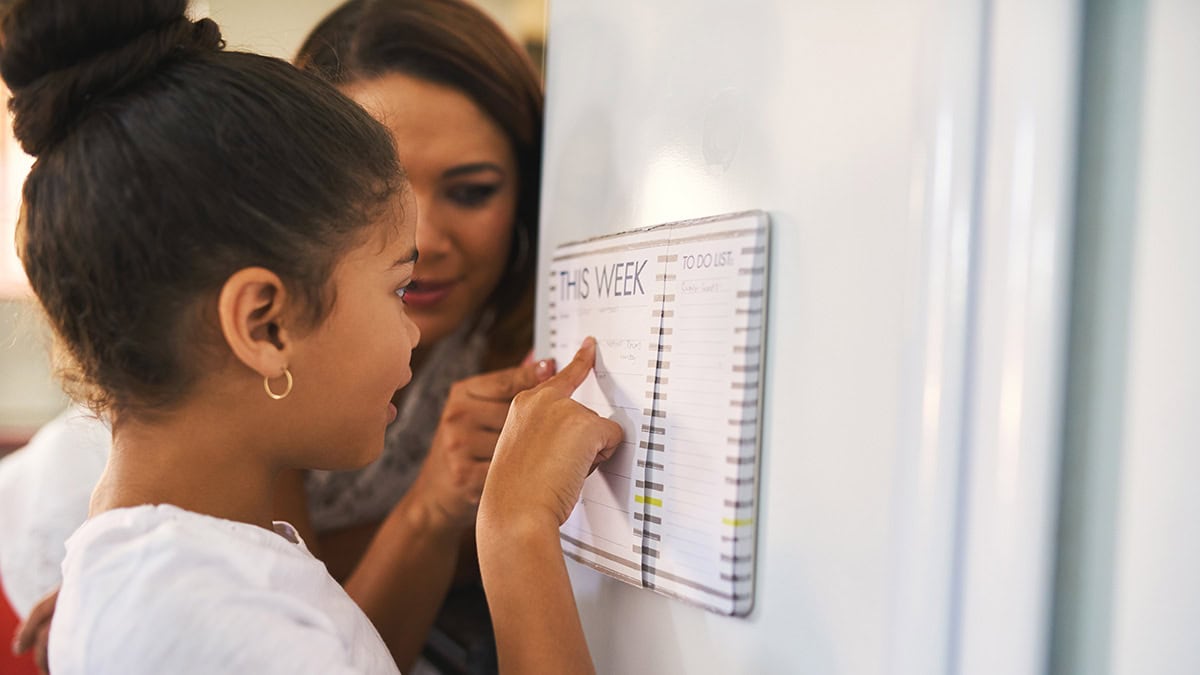
Positive behaviour support strategies work by building new habits: changing the cues around a person, teaching an easier replacement skill, and rewarding it consistently. In a well-known study published in the European Journal of Social Psychology, a new everyday habit took a typical person around 66 days to feel automatic, and between 18 and 254 days across individuals, so the popular 21-day rule is a myth. That means slow progress is usually normal, not a sign that a plan is failing.
Week one felt hopeful. The new morning routine was on the fridge, everyone had agreed to it, and for a few days it worked.
By week three, the old pattern crept back. Someone was tired, the bus came early, and the routine slipped.
If that sounds familiar, you are not doing it wrong. Many families we meet quietly wonder whether the plan has failed, when the habit simply hasn’t had enough time yet.
Families often ask us a simple question: What positive behaviour support strategies work, and why do they take so long?
In this post, we look at how long new habits really take and why that matters when you put positive behaviour support strategies into daily life.
Why Positive Behaviour Support strategies need more than 21 days
You have probably heard that it takes 21 days to form a habit. That is a myth, and a persuasive one, because three weeks sounds achievable.
The research tells a different story. In the study (Lally et al., 2010), 96 volunteers each chose an eating, drinking, or activity habit, linked it to a daily cue (such as after breakfast), and rated how automatic it felt over 12 weeks.
For a typical person, the habit took around 66 days to feel automatic. Among the volunteers whose results could be modelled, it ranged from 18 days to 254 days. The longer figures were estimates, because some people were still improving when the study ended.
That is a wide spread. Some people were quick. Others needed many months.
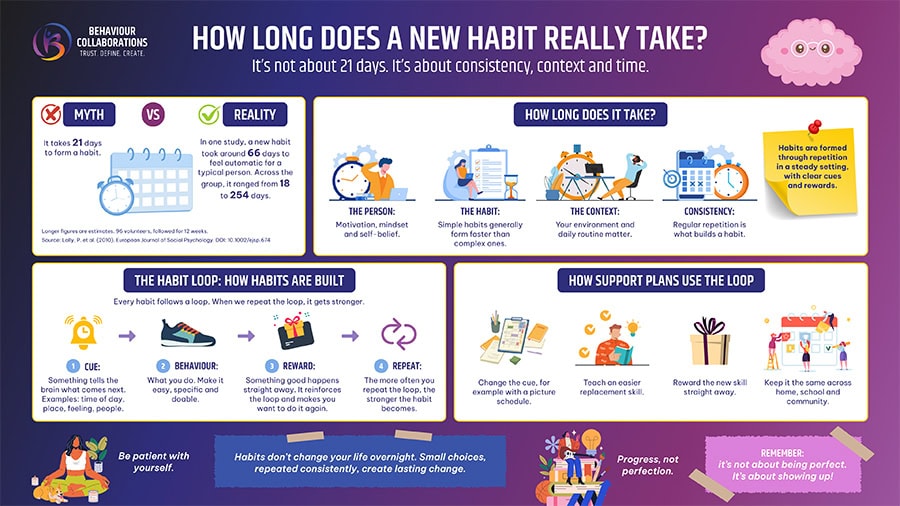
What ‘around 66 days’ means
A single number can hide a lot. ‘Around 66 days’ describes a typical person, not a deadline. Some people got there much earlier, and some took far longer. If your family is at day 40 and it still feels hard, you are well within the normal range.
One caution. The study looked at everyday health habits, not behaviours of concern or disability support, so we treat it as a helpful lens rather than proof. It fits how we plan positive behaviour support, though: change takes repetition, in a steady setting, with clear cues and rewards.
What changes how long a habit takes
The infographic above shows four things that shape the timeline. Each one is something a support network can work with.
The person
Motivation, mindset and self-belief all play a part. When someone feels capable and has a say in the plan, the habit is more likely to stick because people are more likely to try something new when they feel heard. This is why we build each positive behaviour support plan with the person, not for them.
The habit
Simple habits generally form faster than complex ones. A plan that asks for one small change will usually move quicker than one that asks for five at once. Breaking a bigger goal into small steps also gives everyone something to celebrate sooner. Our positive behaviour support strategies start small for exactly this reason.
The context
Habits grow in a steady setting. The room, the time of day and the people nearby all act as cues, which is why a routine that works on a school day can fall apart in the holidays. Part of any plan is to look at the setting and adjust it. For more setting-based ideas, see our post on autism behaviour support strategies.
Consistency
Regular practice is one of the strongest drivers of habit formation. When everyone responds the same way, the person knows what to expect, and the habit gets the repetition it needs. Missed repetitions slow things down, which is why a shared plan matters more than any single strategy.
How Positive Behaviour Support strategies use the habit loop
Every habit follows a loop. A cue triggers it, a behaviour follows, and a reward makes it more likely to happen again. The more the loop repeats, the stronger the habit becomes.

Picture a family getting ready to leave for school. The cue is a gentle chime and a picture card showing shoes. The behaviour is putting on the shoes, which is easier because they live by the door. The reward is a favourite song in the car, straight away.
None of it is complicated. Repeated day after day, in the same setting, the loop starts to run on its own. That is a small picture of positive behaviour support strategies at work.
Behaviour works the same way. Before we change anything, we look at what the behaviour is doing for the person, often through a Functional Behaviour Assessment. What are they trying to say, get or avoid? That question shapes everything that follows.
Once we know, the loop gives us three places to work. We can change the cue, teach an easier behaviour to replace it, and ensure the reward goes to the new skill. Together, that is the heart of the positive behaviour support strategies disability services use, whatever the person’s age or support needs.
Good plans also aim to reduce or eliminate restrictive practices where appropriate. The NDIS Quality and Safeguards Commission publishes guidance on behaviour support and restrictive practices for anyone who wants to read more.
Four examples of Positive Behaviour Support strategies
Each one is a general illustration, not a plan. A real plan is built around the person, their strengths and their daily routines, with help from a positive behaviour support practitioner.
Use a visual routine to change the cue
A picture or written schedule can replace a spoken reminder as the cue that tells someone what comes next. For some people, seeing the steps takes away the stress of guessing.
Teach an easy replacement skill
If a person leaves the table when overwhelmed, a break card might become the new behaviour. It needs to be easy, specific and doable, so it works even on a hard day.
Reward the new skill straight away
A reward only builds a habit if it arrives quickly and clearly follows the new skill. It does not need to be big. Specific praise, a favourite activity or a moment of connection can all work, depending on what matters to the person.
Choose rewards with the person; don’t impose them. What feels rewarding to one person may mean nothing to another, so we ask what they enjoy and what matters to them. That keeps the focus on dignity, choice and strengths.
Keep it the same across settings
A strategy that works only at home is only half built. Families, teachers and support workers need to share the same cues and respond in the same way. With consent, we work with everyone in the person’s network so the habit gets the repetition it needs.
When progress feels slow
Every family hits a wobble. A holiday, a new support worker or a rough week can knock a routine sideways. Positive behaviour support strategies are built to be reviewed, so a wobble is useful information, not failure.
Here is some comfort from the research. In the study, missing a single day did not derail habit formation. Missing many days made it harder, so the goal is to restart the next day rather than abandon the plan.
That is what we mean by progress, not perfection. If the routine keeps slipping, it is time to review the plan rather than push harder. Talk to your positive behaviour support practitioner about what has changed. Our post on Behaviour Support Plan implementation explains why change takes teamwork, and why the whole support network matters.
A simple way to start
You do not need a full plan to begin noticing the loop. Pick one routine that matters in your household, such as the morning or bedtime. Write down what usually sets it off, what happens next, and what happens straight after. If one of the four examples of positive behaviour support strategies above feels too big, shrink it until it feels easy.
These three notes start a conversation with your practitioner about positive behaviour support strategies that fit your household, and they make the next step much clearer. Small notes like these are the raw material of good positive behaviour support.
Support for families in Redlands and beyond
At Behaviour Collaborations, we build positive behaviour support strategies with the person and the people around them. Our Capalaba-based team offers behaviour support in Redlands, including in Capalaba, Cleveland and Thornlands.
TelePBS is also available across our Queensland and Sydney service areas, so distance doesn’t have to get in the way.
Ready to talk to a positive behaviour support practitioner? Call us on 07 3050 3353, email info@behaviourcollaborations.com, or send a referral or enquiry through our website.
Above all, we collaborate.
Frequently asked questions about Positive Behaviour Support strategies
What are the Positive Behaviour Support strategies?
The positive behaviour support strategies disability providers use usually fall into three groups. Proactive strategies change the environment and routines so a behaviour is less likely to happen. Skill-building strategies teach communication and coping skills. Responsive strategies explain how nearby people respond safely if a behaviour does occur. A balanced plan includes all three, aiming to reduce or eliminate restrictive practices where appropriate.
What is the difference between Positive Behaviour Support strategies and a Positive Behaviour Support plan?
The plan is the written document, and the strategies are the actions inside it. Develop a positive behaviour support plan with the person and their support network, then review it over time so it can change as needs change. Think of the plan as the map, and the strategies as the steps along the way.
How will we know our Positive Behaviour Support strategies are working?
Look for small shifts rather than overnight change. Episodes might become shorter, recovery might be quicker, or the person might use the new skill more often. Keeping simple notes while you use positive behaviour support strategies helps, because patterns are hard to spot in the moment. Your practitioner will review those notes with you, and no plan can promise a particular result.
Can Positive Behaviour Support strategies be delivered by telehealth?
Yes, in many cases. TelePBS delivers support through secure telehealth sessions, including carer coaching between appointments. A positive behaviour support plan can mix telehealth and in-person visits, depending on what suits the person and where they live. We offer this across our Queensland and Sydney service areas, and we will confirm the best option once we know your suburb.
Do we need a diagnosis to get a Positive Behaviour Support plan?
Not always. You can often start a positive behaviour support plan without a formal diagnosis. What matters most is the person’s support needs and whether their NDIS plan includes funding for behaviour support. If you are not sure, contact us, and we can help you work out the next step.
What does a Positive Behaviour Support practitioner do?
A positive behaviour support practitioner writes the plan with you, coaches the people who will use it, and reviews progress as circumstances change. With consent, they also liaise with schools, support workers, and other providers so everyone is on the same page. Our practitioners work with participants and families across our Queensland and Sydney service areas.
NDIS positive behaviour support: 8 questions to ask before you choose a provider

NDIS Social and Community Participation: Why consistent support worker records matter
Position Vacant: Behaviour Support Practitioner
Join Our Blog
Subscribe for insights and updates
Check back regularly for new posts covering Positive Behaviour Support plans, communication strategies, emotional regulation, family engagement, and everyday approaches that can support wellbeing at home, school, work, and in the community. We also share guidance on navigating support systems and getting the most from services, with content relevant to Brisbane and families across Queensland.
"*" indicates required fields
Need support creating or implementing a Positive Behaviour Support Plan? If you are looking for guidance with Positive Behaviour Support, counselling and mental health support, or reports and documentation, our team can help you understand the next best step. Contact our Brisbane behaviour support team for guidance tailored to your situation.